Test 1 Can a transparent coating be detected at all?
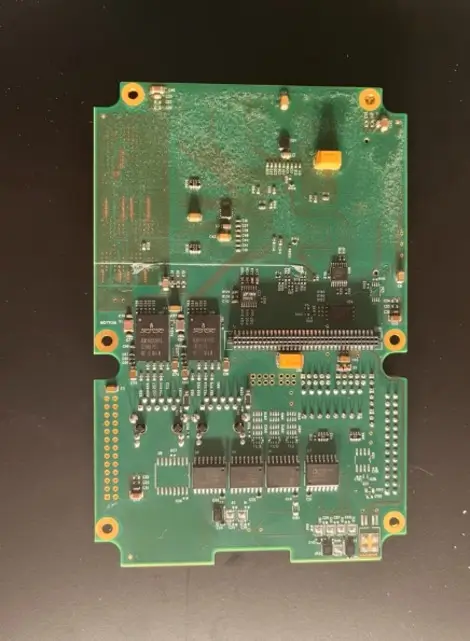
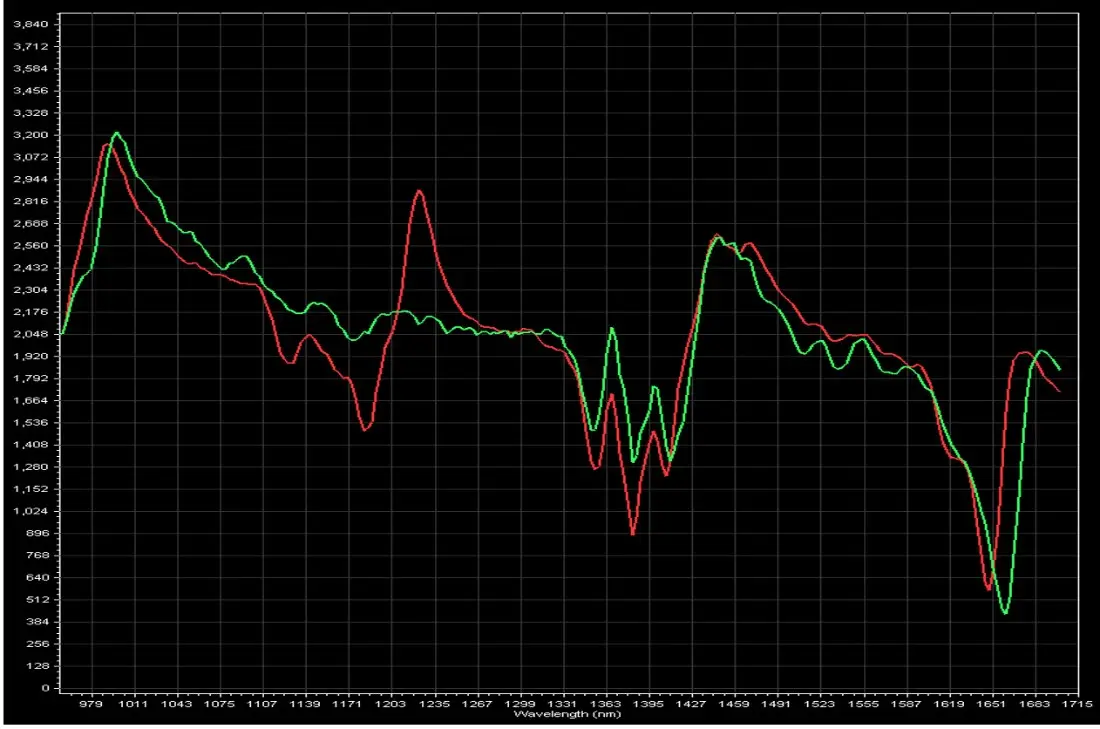
A hydrocarbon-based acrylic coating applied to one third of the board, trained as two classes: coated and uncoated.
- Coated
- Uncoated

- Coated
- Uncoated
Material-level inspection for electronics manufacturing
Identify coating presence and coating type in a single non-contact pass, including transparent coatings that look identical under normal light. No sample preparation, no destructive testing.
The challenge
Conventional vision cannot see differences that are critical to quality. Variation in coatings, resins and solder alloys, or contamination, may be invisible, yet it can cause defects or reduce reliability.
Thin or uneven coatings are invisible to the eye but change how the assembly survives moisture, dust and temperature.
Different resins and polymers look the same under normal light, yet behave very differently over the product lifetime.
Flux residues, oils and particulates are hard to detect and can end up as resistance drift or field failures.
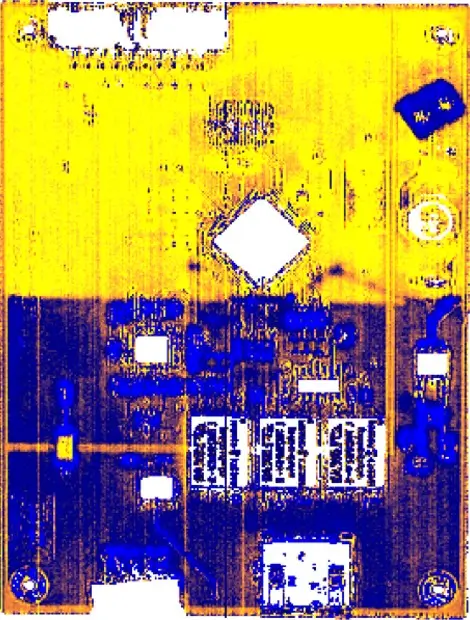
One board, one measurement, two views. Drag to compare what an appearance-based check records with what the material signal shows.
Both frames come from the same measurement, so every feature stays in register as you drag.


Separates similar polymers, resins and conformal coatings by their spectral signature.
Identifies subtle formulation or batch differences before they reach the field.
Turns coating and material quality into a plain, recorded signal instead of an opinion.
Flux residues, oils and particulates that stay invisible in a standard check.
Detects thin, uneven or missing coatings, including coatings with no UV tracer.
Proof point
Two separate tests on PCB samples, each trained with two classes, carried out in a laboratory setup.
A hydrocarbon-based acrylic coating applied to one third of the board, trained as two classes: coated and uncoated.
Acrylic conformal coating on the top half, polyurethane-alkyd resin on the bottom half, trained as one class each.
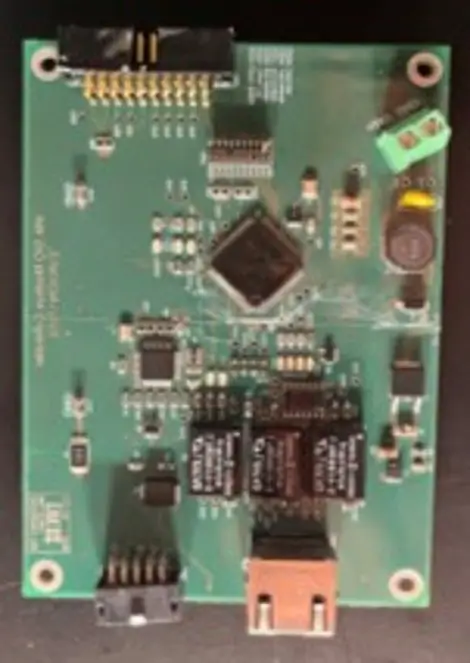


Two tests on PCB samples. First, a hydrocarbon-based acrylic coating applied to one third of a board, trained as two classes: coated and uncoated. Second, an acrylic conformal coating on the top half and a polyurethane-alkyd resin coating on the bottom half, trained as one class each. All three coatings are transparent.
HELIOS EC64 real-time hyperspectral line-scan camera on an EVK LabStation: four halogen illumination units emitting across the NIR range of 930–1700 nm, a linear actuator moving the sample underneath the camera, and 256 wavelength pixels per spatial point. Training points were marked on the coated and uncoated areas, and the classification models were built in EVK SQALAR.
Detecting a clearcoat is feasible, and two coatings can be told apart on a PCB. The classified images show slight misclassifications, mostly on areas that are lighter or darker, or on parts that return a strong spectral signal themselves.
Where this fits
Conformal coating is qualified under IPC-CC-830 and inspected against IPC-A-610 acceptance criteria, usually visually or under UV. Hyperspectral imaging adds what those checks cannot confirm: which material is actually there, including coatings that carry no UV tracer.
Applications
One application is validated in our lab. The others are plausible and start with a feasibility check.
Verify presence, coverage and coating type.
Validated in our labDetect voids, inclusions or the wrong material.
Feasibility on requestIdentify dielectric materials and surface compounds.
Feasibility on requestDifferentiate resins and polymers for consistency.
Feasibility on requestFind residues, oils, particulates and foreign material.
Feasibility on requestTrack variation over time to improve line quality.
Feasibility on requestSetup, spectra and classified results for two transparent coating tests on a PCB, including where the method reaches its limits.
Get the feasibility studyIn electronics manufacturing, some of the most consequential coating problems are also the hardest to see.
Read blog postThe NIR line-scan camera used in the measurement: 930–1700 nm, 256 wavelength pixels per spatial point, real-time classification.
Download the data sheetFor your own assessment
PCB coating inspection with hyperspectral imaging: setup, spectra, classified results, and the conditions under which detection reaches its limits.
PCB Coating Feasibility Study
PDF · 9 pages · HELIOS EC64 laboratory setup, two tests with two classes each.